On the questions and projects related to context-free grammars and parsing, we use a variety of file formats to represent CFGs, derivations, and parsing DFAs. These file formats are created by combining various components, which are described below.
A CFG component
starts with a header line .CFG,
followed by a sequence of lines representing the
rules of the CFG.
Each line after the header has the form:
left-hand-side-symbol right-hand-side-symbols
Where left-hand-side-symbol
is a single symbol, and right-hand-side-symbols
is either a sequence of symbols separated by whitespace,
or the special string .EMPTY.
A symbol is a string of printable
non-whitespace ASCII characters that is not equal to
.EMPTY.
These lines should be interpreted as CFG production rules.
For example, the line expr expr - term
would represent the rule expr → expr - term.
The special string .EMPTY
represents the empty string (normally denoted
ε); so the line S .EMPTY
would represent the rule S → ε.
The other elements of the CFG may be inferred from the production rules as follows:
left-hand-side-symbol of the first line
after the header is the start symbol.
left-hand-side-symbol of some rule.
Consider the following CFG with start symbol expr:
expr → expr + term | term
term → term * factor | factor
factor → # | id
As a CFG component, it would look like this:
.CFG
expr expr + term
expr term
term term * factor
term factor
factor #
factor id
Here is an example that uses the empty string:
S → (S)S | ε
As a CFG component, it would look like this:
.CFG
S ( S ) S
S .EMPTY
Note the whitespace in the first rule. If we wrote it as
S (S)S, then (S)S would be
treated as a single symbol instead of four symbols.
A DERIVATION component
starts with a header line .DERIVATION,
and is followed by a sequence of lines
representing the steps of
a leftmost derivation of a string,
using the rules of the specified CFG.
Each line contains a single rule from the CFG, representing the rule that was applied to expand the leftmost nonterminal at that step the derivation. These rule lines have the same format as the rule lines in a CFG component.
The derivation steps must satisfy the following conditions to be valid:
The derivation steps can optionally be preceded by whitespace. This allows you to use indentation to organize your derivations, which you may find useful.
Suppose this is our CFG component:
.CFG
expr expr + term
expr term
term term * factor
term factor
factor #
factor id
Here is a DERIVATION component for this CFG:
.DERIVATION
expr expr + term
 expr term
  term factor
   factor id
 term term * factor
  term factor
   factor #
  factor id
The indentation is optional, but makes it a little easier to see which line expands which nonterminal. This represents the following leftmost derivation:
expr
⇒ expr + term
⇒ term + term
⇒ factor + term
⇒ id + term
⇒ id + term * factor
⇒ id + factor * factor
⇒ id + # * factor
⇒ id + # * id
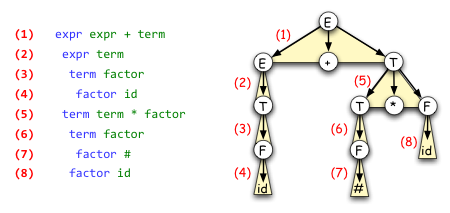
The image below shows the correspondence
between the leftmost derivation and the parse
tree for the string id + # * id.
A TRANSITIONS component
starts with a header line .TRANSITIONS,
followed by a sequence of lines
encoding the
transitions of an SLR(1) parsing DFA for
the given CFG.
States of the DFA are represented by non-negative integers, and the initial state of the DFA is state 0.
To completely specify an SLR(1) parsing DFA, a REDUCTIONS component (discussed below) is also required.
Each line after the header has the form:
from-state symbol to-state
Where from-state and to-state
are non-negative integers, and symbol is a terminal
or nonterminal symbol from the CFG.
A REDUCTIONS component
starts with a header line .REDUCTIONS,
followed by a sequence of lines
encoding
information about the reducible items
in the SLR(1) parsing DFA.
To completely specify an SLR(1) parsing DFA, a TRANSITIONS component (discussed above) is also required.
Each line after the header has the form:
state-number rule-number tag
Where state-number and rule-number
are non-negative integers, and tag
is either a terminal symbol from the CFG,
or the special string .ACCEPT.
Each of these lines has the following meaning:
state-number contains a reducible
item corresponding to rule rule-number,
where the rules are numbered in the order they appear
in the CFG section, starting from 0.
tag is
a terminal symbol,
this symbol is one of the "lookahead tags"
for the reducible items. That is, it is an elements
of the Follow set of the left-hand-side of the item's
rule.
tag is the special string .ACCEPT,
this indicates that the parser can only reach this state after
all input is consumed, and the input string should be accepted
after this reduction.
.ACCEPT
is never a terminal in the CFG.
S → BOF expr EOF
expr → expr - term
expr → term
term → id
term → ( expr )
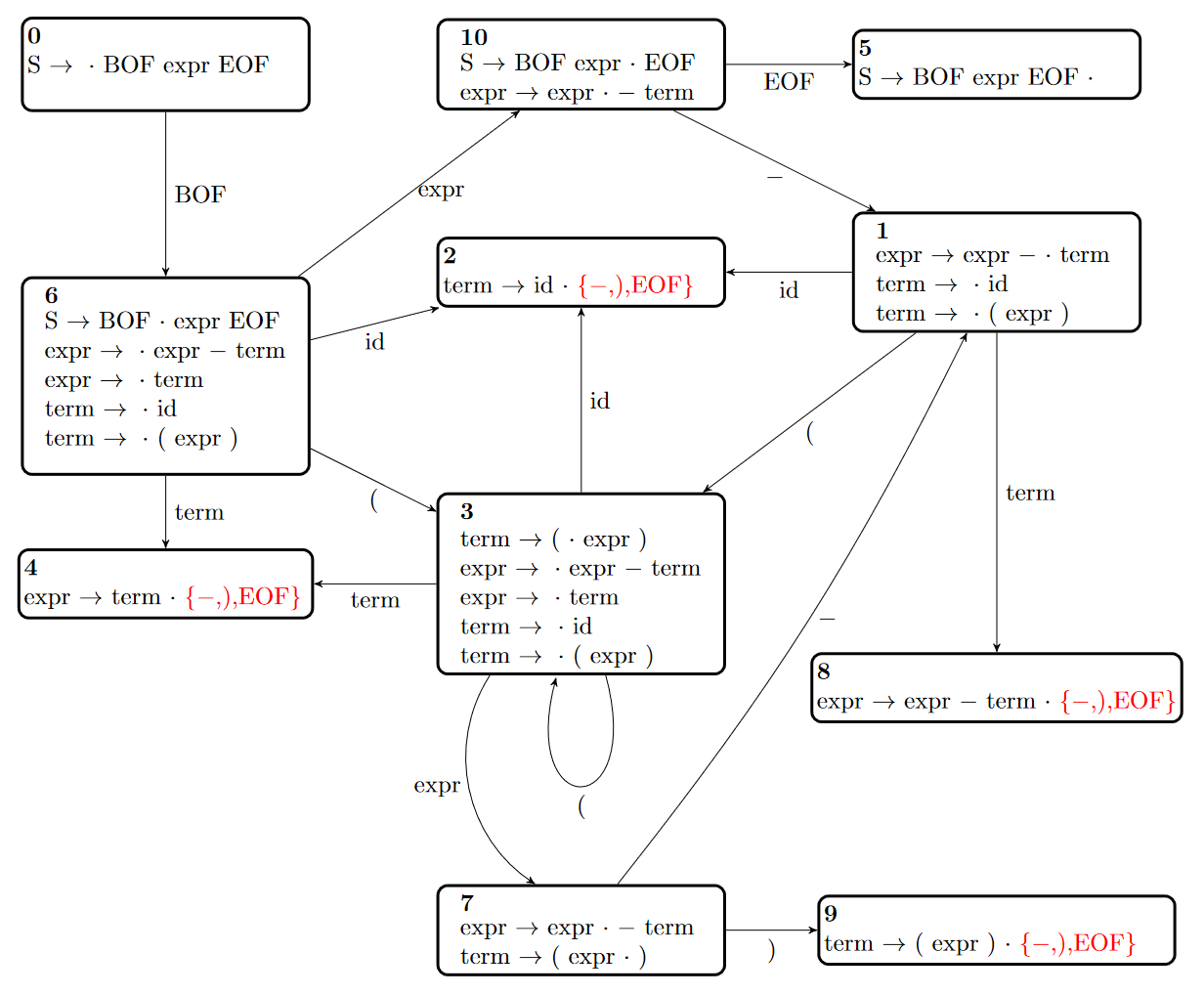
The components below encode this CFG and its SLR(1) DFA.
.CFG S BOF expr EOF expr expr - term expr term term id term ( expr ) .TRANSITIONS 0 BOF 6 1 id 2 1 ( 3 1 term 8 3 id 2 3 ( 3 3 term 4 3 expr 7 6 id 2 6 ( 3 6 term 4 6 expr 10 7 - 1 7 ) 9 10 - 1 10 EOF 5 .REDUCTIONS 2 3 - 2 3 ) 2 3 EOF 4 2 - 4 2 ) 4 2 EOF 5 0 .ACCEPT 8 1 - 8 1 ) 8 1 EOF 9 4 - 9 4 ) 9 4 EOF |
|