Pair Programming#
Pair programming is a software development practice where two people work together at a single computer, collabrating to solve a problem.
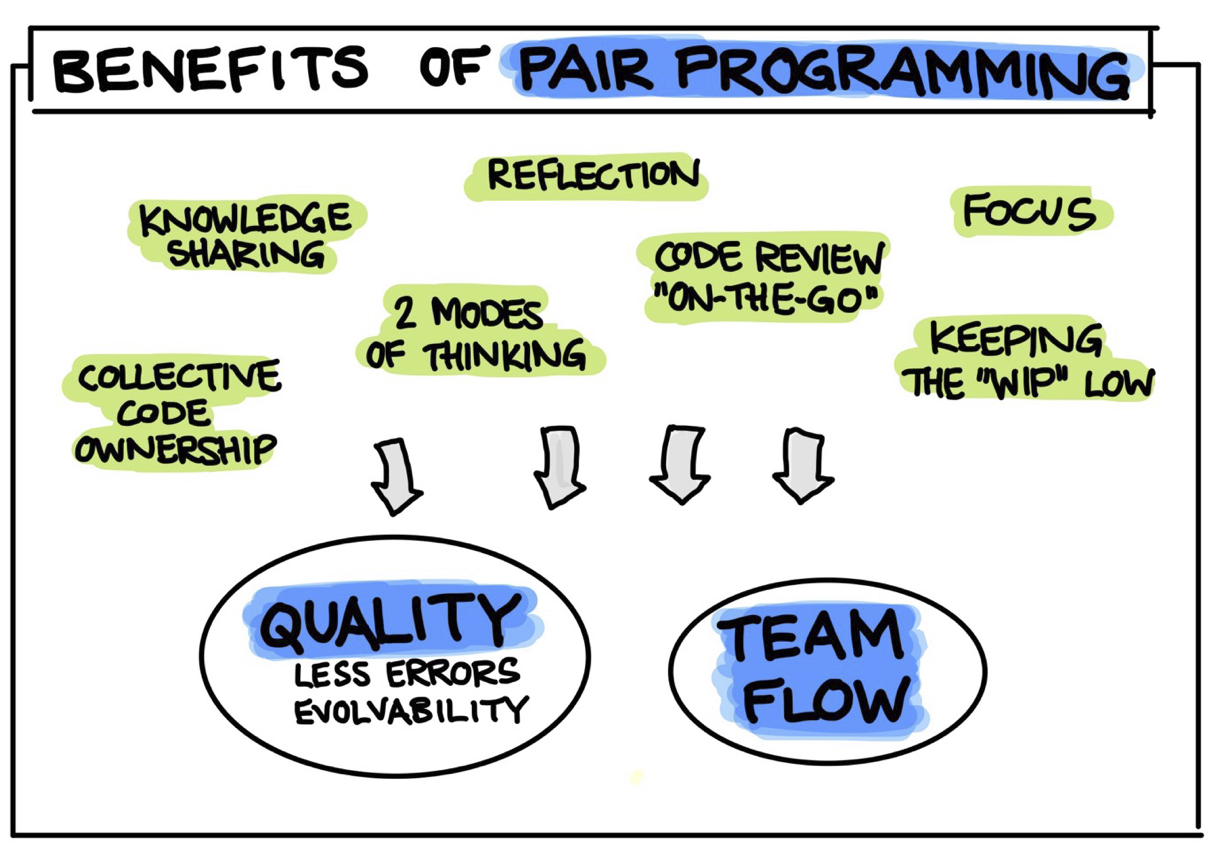
This was originally an Extreme Programming (XP) practice. The motivation was to reduce the number of defects, by having two people actively work on design/implementation together.
While a pair of developers work on a task together, they do not only write code, but they also plan and discuss their work. They clarify ideas on the way, discuss approaches and come to better solutions 1.
Guidelines#
Physical Setup#
Ideally, a pair works together in the same space.
- Make sure that both of you can sit facing the computer.
- Agree on the computer setup (key bindings, IDE etc).
- Check if your partner has any particular needs (e.g. larger font size, higher contrast, …)
Remote Setup#
There are also development tools that are designed to specifically support remote sharing.
Let’s discuss how this will actually work!
Pairing Styles#
Driver and Navigator Pairing#
Classic form of pair programming.
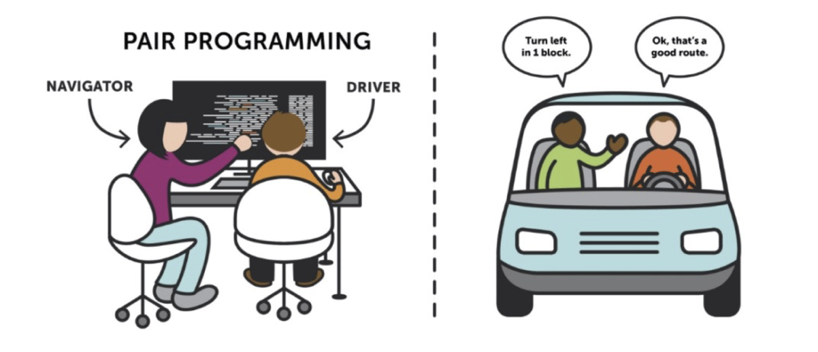
The Driver is the person at the wheel, i.e. the keyboard.
- Focused on completing the goal at hand
- Should talk through what she is doing.
The Navigator is in the observer position.
- Reviews the code on-the-go, gives directions and shares thoughts.
- Watches for larger issues, bugs
- Makes notes of potential next steps or obstacles.
- The navigator should have a pad of paper (not a cell phone).
A common flow goes like this:
- Start with a reasonably well-defined task. Pick a requirement or user story.
- Write down your goals and keep track of them (paper, whiteboard).
- Agree on one small goal at a time. This can be defined by a unit test, or by a commit message, or some goal that you’ve written down.
- Discuss the overall design as a team. The driver then implements it while the navigator watches.
As the navigator, you oversee medium-term thinking and planning.
- Provide feedback on the immediate goal. Anything else should be written down for afterwards.
As the driver, focus on the immediate goal.
- You are coding.
- Explain what you are doing to the navigator. Ask for feedback if needed.
Ping-Pong Pairing#
This technique is ideal when you have a clearly defined task that can be implemented in a test-driven way.
- “Ping”: Developer A writes a failing test
- “Pong”: Developer B writes the implementation to make it pass.
- Developer B then starts the next “Ping”, i.e. the next failing test.
- Alternate over and over.
Each “Pong” can also be followed by refactoring the code together, before you move on to the next failing test.
This is a great style if you’re using TDD. It’s a suitable alternative to classic pairing in this course if you wish.